[Télécharger] Narrating the Nation-state in the African Novel: Chinua Achebe, Ngugi wa Thiong'o, Ayi Kwei Armah and Kofi Awoonor (English Edition) de Abdelkader Babkar Livre PDF Gratuit
Télécharger Narrating the Nation-state in the African Novel: Chinua Achebe, Ngugi wa Thiong'o, Ayi Kwei Armah and Kofi Awoonor (English Edition) de Abdelkader Babkar En Ligne
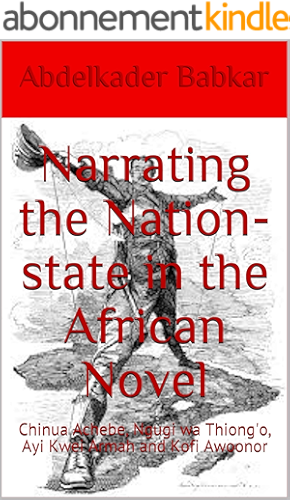
Télécharger "Narrating the Nation-state in the African Novel: Chinua Achebe, Ngugi wa Thiong'o, Ayi Kwei Armah and Kofi Awoonor (English Edition)" de Abdelkader Babkar PDF Ebook En Ligne
Auteur : Abdelkader Babkar
Catégorie : Boutique Kindle,Ebooks Kindle,Ebooks en langues étrangères
Broché : * pages
Éditeur : *
Langue : Français, Anglais
The idea of the nation or nationalism in relation to Africa and African literature has been widely dealt with in modern African literature, arising from the fact that writers are bent on expressing their concern about the future of their countries. Chinua Achebe, Ayi Kwei Armah, Ngugi wa Thiong’o and Kofi Awoonor are such writers who have made great artistic efforts to portray an Afrotopia, or at best viable socio-political systems in the wake of colonial situation.The present work aims to examine closely these novelists’ ideological convictions as they are expressed in their fictions and often shown to be in opposition to the practices established by the state apparatuses in place.This book shows how the African situation has been characterised in the African novels by both a common continental experience and a number of facts that dramatise the historical predicament of slavery, colonialism and a problematic independence. These representations carry dialogical voices which underpin the authoritative voice of the authors. The narratives of the nation are shown to be ambivalent, for they seem to act in defence of the novelists’ culture, yet they jettison its very quintessence by the sceptical view they reflect about its significance in modern times.Caught between the imperatives of modernity and the nostalgic drives of the past, the novelists are somehow drawn to condemn the metropolis and to celebrate it at the same time.The point is to accept the construction of the nation-state in connection with universal concepts developed by the Western world and Europe essentially. The different ‘utopias’ offered by the writers under scrutiny cannot be divorced from the theory and practice that have led to the construction of European models of nation-states. Hence our reliance on important scholarly works in the field, particularly Elie Kedourie’s Nationalism, Eric Hobsbawm’s Nations and Nationalism Since 1780, Ernest Gellner’s Nations and Nationalsim. But for the theoretical link between nationalism and literary interpretation, Benedict Anderson’s Imagined Communities, Homi Bhabha’s Nation and Narration and The Location of Culture, Edward Said’s Orientalism and Culture and Imperialism and Bakhtin’s The dialogical Imagination are fundamental supports for my discussion.Critics that have approached this subject are restrictive in number, but I have taken account of the studies carried out by James Ogude on Ngugi, Leif Lorentzon on Armah, for example, or general works like Abiola Irele’s The African Experience in Literature and Ideology or Kanneh Kadiatu’s African Identities, amongst others, to substantiate the discussionDue appreciation of the different styles used by the writers is expressed here from a modernism used by early Armah and Awoonor, to the realism of Achebe and Marxist-populist treatment of fiction and nation-building of Ngugi, as well as the essentialist slant that can be studied in Armah’s later fiction.Concepts such as hybridity, ambivalence, liminality, developed by Bhabha, are useful elements of analysis in the examination of the evolution of prose fiction in Africa from the early writings of Achebe to the later works of Armah and Ngugi. They allow us to see how the African novelists produce meanings that underscore the realities and difficulties met in the construction of stable and genuinely independent nation-states in Africa.
Télécharger Narrating the Nation-state in the African Novel: Chinua Achebe, Ngugi wa Thiong'o, Ayi Kwei Armah and Kofi Awoonor (English Edition) de Abdelkader Babkar Livres En Ligne
Narrating the Nation in the African Novel: Chinua Achebe ~ Pris: 403,-. heftet, 2016. Sendes innen 5-7 virkedager. Kjøp boken Narrating the Nation in the African Novel: Chinua Achebe, Ngugi wa Thiong'o, Ayi Kwei Armah and Kofi Awoonor av Abdelkader Babkar (ISBN 9781511816007) hos Adlibris. Fri frakt. Vi har mer enn 10 millioner bøker, finn din neste leseopplevelse i dag! Alltid lave priser, fri frakt over 299,- / Adlibris
Awoonor, Kofi 1935-2013 [WorldCat Identities] ~ Narrating the nation in the African novel : Chinua Achebe, Ngugi wa Thiong'o, Ayi Kwei Armah and Kofi Awoonor by Abdelkader Babkar ( Book ) Contemporary Black biography. profiles from the international Black community ( Book )
The African Novel and the Modernist Tradition by David I ~ Chinua Achebe Things Fall Apart (1958), one of the first African novels to gain international acclaim, appropriated its title from the spirit of the modernist age. Yet discussions of the African novel, novels that were published in quick succession after Achebe's debut, tend to ignore the significance of his choice of title.
(DOC) THEMES IN AFRICAN LITERATURE / aneeta joseph ~ “Ayi Kwei Armah’s Novels of Liberation” African Nebula 3 (2011): 48-59. Web. 20 November 2014. Viljoen, Louise. “Displacement in the literary texts of black Afrikaans writers in South Africa.” Journal of Literary Studies 21. 1-2 (2005): 93-118. Web. 20 November 2014. Sakhsi. “Colonial Conflicts leads to Alienation and Rootlessness in Achebe’s No Longer at Ease.” IOSR Journal of .
African Books Collective: Welcome ~ by Chinua Achebe Fourth Dimension Publishing Company, Nigeria Not My Time to Die by Yolande Mukagasana Huza Press, Rwanda Mobile Africa edited by Mirjam van Reisen, Munyaradzi Mawere, Kinfe Abraha Gebre-Egziabher Langaa RPCIG, Cameroon Award. Sosu's Call by Meshack Asare Sub-Saharan Publishers, Ghana Award. Song of Lawino and Song of Ocol by Okot p'Bitek East African Educational Publishers .
Morning Yet on Creation Day: Essays by Chinua Achebe ~ Chinua Achebe was a novelist, poet, professor at Brown University and critic. He is best known for his first novel, Things Fall Apart (1958), which is the most widely read book in modern African literature. Raised by Christian parents in the Igbo town of Ogidi in southeastern Nigeria, Achebe excelled at school and won a scholarship for undergraduate studies. He became fascinated with world .
African literature : an anthology of criticism and theory ~ Towards a Marxist sociology of African literature / Omafume F. Onoge --Writers in politics: the power of words and the words of power / Ngugi wa Thiong'O --National liberation and culture / Amilcar Cabral --Concerning national culture / Agostinho Neto --Masks and Marx: the Marxist ethos vis-a-vis African revolutionary theory and praxis / Ayi Kwei Armah --Marxist aesthetics: an open-ended .
African literature - English / Britannica ~ African literature - African literature - English: Early works in English in western Africa include a Liberian novel, Love in Ebony: A West African Romance, published in 1932 by Charles Cooper (pseudonym Varfelli Karlee), as well as such works of Ghanaian pulp literature as J. Benibengor Blay’s Emelia’s Promise and Fulfilment (1944). R.E. Obeng, a Ghanaian, wrote Eighteenpence (1941), an .
On Dambudzo Marechera: The Life and Times of an African ~ Up until the time he appeared, the leading writers, like Chinua Achebe, Ngugi wa Thiong’o, and Ayi Kwei Armah, had written in an accessible, social realist mode, and most of the writers that came immediately after them adopted the same style, not only because of the earlier writers’ influence, but also because of the effectiveness of this very accessible style in presenting the anti .
Art of Africa: The 50 best African artists / The ~ CHINUA ACHEBE, AUTHOR (Nigeria) The father of the African novel, Achebe made his literary debut in 1958 with the classic Things Fall Apart, which has been translated into 50 languages. It is hard .
Postcolonial African Writers: A Bio-bibliographical ~ This reference book surveys the richness of postcolonial African literature. The volume begins with an introductory essay on postcolonial criticism and African writing, then presents alphabetically arranged profiles of some 60 writers, including Chinua Achebe, Nadine Gordimer, Bessie Head, Doris Lessing, Tsitsi Dangarembga, Tahbar Ben Jelloun, among others.
Postcolonial African Writers: A Bio-bibliographical ~ Postcolonial African writers have made an enormous contribution to world literature. These writers frequently examine such issues as emerging identities in the postcolonial climate, neo-colonialism and new forms of oppression, cultural and political hegemonies, neo-elitism, language appropriation, and economic instability. During the last decade, their works have elicited increasing critical .
African literature - Students / Britannica Kids / Homework ~ In the 1950s descriptions of tribal life were common in West African novels. Nigerian Chinua Achebe’s . about social and political problems in the new nations. In The Beautyful Ones Are Not Yet Born (1968), for example, Ayi Kwei Armah criticized the corruption, greed, and arrogance of the black officials who replaced Europeans in his native Ghana. Leonard Kibera of Kenya published a .
African Writers Series - Wikipedia ~ African Writers Series (AWS) is a series of books by African writers that has been published by Heinemann since 1962. The series has ensured an international voice to major African writers—including Chinua Achebe, Ngũgĩ wa Thiong'o, Steve Biko, Ama Ata Aidoo, Nadine Gordimer, Buchi Emecheta, and Okot p'Bitek.The emphasis is on Anglophone Africa, although a number of volumes were translated .
Ayi Kwei Armah - Authors' Calendar ~ In the mid-1960s, Armah and other scholars, such as Ngugi Wa Thiong'o, began to call for the adoption of Kiswahili as the continental language. Dismissing Senghor's Negritude as essentially contrary to the needs of Africans, he joined Wole Soyinka, Lewis Nkosi, Chinua Achebe, and other English-speaking writers and intellectuals of the 1960s, who felt uncomfortable with an ideology that was .
Chinua Achebe - Wikipedia ~ Chinua Achebe (/ ˈ tʃ ɪ n w ɑː ə ˈ tʃ ɛ b eɪ /; born Albert Chinụalụmọgụ Achebe, 16 November 1930 – 21 March 2013) was a Nigerian novelist, poet, professor, and critic. His first novel Things Fall Apart (1958), often considered his masterpiece, is the most widely read book in modern African literature.. Raised by his parents in the Igbo town of Ogidi in southeastern Nigeria .
Amazon Best Sellers: Best African Art History ~ Kindle Edition. $9.99 #2. Afrotopia (Univocal) Felwine Sarr. 4 . Narrating the Nation-state in the African Novel: Chinua Achebe, Ngugi wa Thiong'o, Ayi Kwei Armah and Kofi Awoonor Abdelkader Babkar. Kindle Edition. $17.00 #34. Modernist Art in Ethiopia (New African Histories) Elizabeth Giorgis. 5.0 out of 5 stars 1. Kindle Edition. $37.95 #35. 3 in 1 Books: Real Estate + Rental Property .
Judged by Its Covers / Lapham’s Quarterly ~ These books—featuring authors such as Chinua Achebe, Ngugi wa Thiong’o, Ayi Kwei Armah, Buchi Emecheta, and Nuruddin Farah—were part of the African Writers Series, published by Heinemann Educational Books in the mid-twentieth century. Now these brightly colored volumes are hard to find. When you do track them, it’s often for $8, $10, even $20 or $30—a far cry from the small stacks to .
African literature - Wikipedia ~ African literature is literature of or from Africa and includes oral literature (or "orature", in the term coined by Ugandan scholar Pio Zirimu).. As George Joseph notes in his chapter on African literature in Understanding Contemporary Africa, whereas European views of literature often stressed a separation of art and content, African awareness is inclusive:
Toni Morrison and Africa – Global Studies Blog ~ Amos Tutuola, Ayi Kwei Armah, Ezekiel Mphahlele, James Ngugi [Ngugi wa Thiong’o], Bessie Head, Christina Ama Ata Aidoo, Mongo Beti, Leopold Senghor, Camara Laye, Ousmane Sembene, Wole Soyinka, John Pepper Clark: the jolt these writers gave me was explosive. The confirmation that African literature was not limited to Doris Lessing and Joseph Conrad was so stunning it led me to secure the aid .
African Writers Series — Wikipédia ~ African Writers Series (AWS) est une collection de la maison d'édition Heinemann Education Books, société issue du groupe britannique Heinemann.Elle est fondée en 1962, enrichie jusqu'en 2003 et reprise par Pearson en 2011. Elle a joué un rôle majeur dans la publication et la reconnaissance d'écrivains africains, comme Chinua Achebe, Ngũgĩ wa Thiong'o, Steve Biko, Ama Ata Aidoo .
EverythinLiterature: History of Nigerian literature ~ For instance, Chinua Achebe’s first novel, Things Fall Apart, published in 1958, has Igbo folklore, thereby preserving the African elements despite the English prose. According to the Ghanaian poet, Kofi Awonoor, Igbo proverbs “are intricately woven into the fabric of his style, completely absorbed to the extent that they constitute one of the most significant features of his totally .
African Timelines Part V: Post-Independence Africa ~ Ngugi wa Thiong’o publishes Petals of Blood, a major novel in English attacking present-day Kenyan society, joining his earlier novels [Weep Not, Child, 1964; The River Between, 1965; A Grain of Wheat, 1967], short stories, and plays dealing with many aspects of Kenyan lives within colonialism and neocolonialism, the impact of Christianity and Westernized education, the cultural practice of .
50 Book List / Department of English ~ Chinua Achebe, Things Fall Apart (1959; Ama Ata Aidoo, Our Sister Killjoy (1977; Mulk Raj Anand, Coolie; Ayi Kwei Armah, The Beautiful Ones Are Not Yet Born (1968) Mariama Ba, So Long a Letter; Alejo Carentier, The Kingdom of This World (1949) Aime Césaire, A Tempest (1969) Michelle Cliff, No Telephone To Heaven (1987) Coleman, George the Younger. Inkle and Yarico (1787) Can be in 18th C list .
Comments
Post a Comment